

About Course
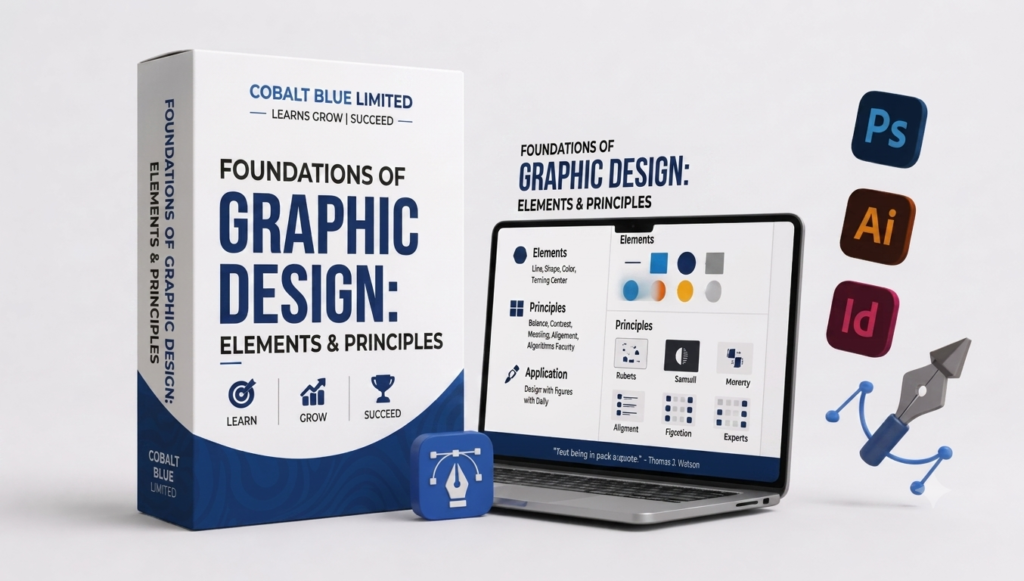
Module Overview: This foundational module introduces students to the core building blocks and guiding rules of graphic design. You’ll learn to see design through a professional lens, understanding how elements like line, shape, color, and texture combine and interact according to principles such as balance, contrast, and hierarchy to create effective and aesthetically pleasing visual communications. This knowledge is essential for creating compelling designs in any medium.
Learning Objectives: Upon completion of this module, students will be able to:
-
Identify and define the fundamental elements of design.
-
Understand and apply the key principles of design.
-
Analyze existing designs to critique their use of elements and principles.
-
Develop foundational skills in composition and visual organization.
-
Begin to articulate design choices using appropriate terminology.
-
Create simple visual compositions that demonstrate an understanding of design fundamentals.
Topics Covered:
1. Introduction to Graphic Design Theory * What is Graphic Design? (Beyond just making things look pretty) * The Role of a Graphic Designer * Understanding Visual Communication * Design as Problem Solving
2. The Elements of Design (The Building Blocks) * Line: Direction, weight, type (implied, actual) * Shape: Geometric, organic, abstract, positive/negative space * Form: Three-dimensional qualities (implied in 2D) * Space: Positive and negative space, depth, perspective * Color: Color theory basics (hue, saturation, value), color schemes, emotional impact of color * Texture: Visual vs. tactile texture, creating depth and interest * Type (Typography): Introduction to typefaces, fonts, basic anatomy of type, readability (deeper dive in a later module)
3. The Principles of Design (The Guiding Rules) * Balance: Symmetrical, asymmetrical, radial * Contrast: Creating visual interest through differences (size, color, shape, texture) * Emphasis/Dominance: Highlighting key elements, focal point * Hierarchy: Guiding the viewer’s eye through information * Rhythm/Repetition: Creating consistency and movement * Proportion/Scale: Relationship of size between elements * Unity/Harmony: How elements work together as a cohesive whole * Movement: Directing the eye through a composition
4. Composition Basics * Rule of Thirds * Golden Ratio (brief introduction) * Grids and Alignment * Cropping and Framing
5. Practical Application & Critiques * Analyzing examples of good and bad design * Exercises in applying elements and principles * Peer critiques and feedback
Assignments/Activities:
-
Visual Journal: Collect and analyze examples of designs, noting elements and principles used.
-
Abstract Composition Exercise: Create a design using only basic shapes and colors to demonstrate balance, contrast, and rhythm.
-
Color Scheme Project: Develop various color palettes and explain their emotional impact.
-
Critique Session: Present and discuss design analysis with peers.
Course Content
Full Design
-
Part 1
Feedback
Reviews (21)
- All Levels
- 38
- June 21, 2026
- Certificate of completion


Cynthia Bell
Gary Morgan
Laura Cook
Jacob Reed
Sharon Rogers
Ryan Morris